Your last proposal cost somewhere between $50,000 and $150,000 to produce. Your team spent six weeks writing, reviewing, rewriting, and formatting. You submitted on time, checked every box in the compliance matrix, and felt genuinely good about your technical approach.
Then you lost. And the debrief told you what you already suspected: the winner knew things you didn't. They understood the agency's pain points at a level your team never reached. They priced within 3% of the government estimate. They named key personnel the agency already trusted. None of that came from the RFP itself. It came from months of intelligence gathering that started long before the solicitation hit SAM.gov.
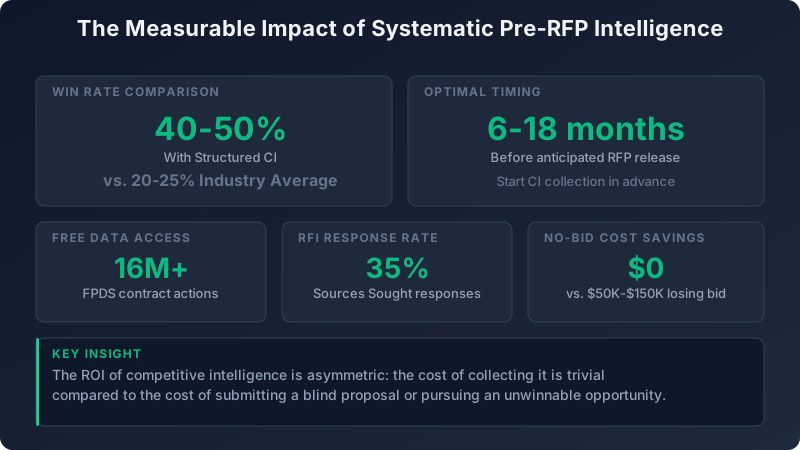
The uncomfortable truth is that most GovCon teams treat competitive intelligence as something you do after the RFP drops, if you do it at all. That's backwards. The capture teams winning at 40%+ rates are the ones who built their competitive picture 6 to 18 months before the solicitation, using data that's entirely free and publicly available. The gap between winners and also-rans isn't talent or writing ability. It's information asymmetry, and it's fixable.
The $0 Intelligence Gap That Costs You Millions
Here's a number that should bother you: the average federal contractor spends fewer than 5 hours on competitive research before committing $50K to $150K in proposal costs. Five hours. That's less time than most people spend choosing a car.
The reason is structural, not laziness. Most BD teams are small. Capture managers juggle 8 to 12 opportunities. Nobody has a "competitive intelligence analyst" on staff. So intelligence becomes ad-hoc, something you do when you remember, using whatever data you stumble across.
But the math is simple. If your win rate is 20% (the industry average for competed procurements), you're burning four proposals for every win. At $100K per proposal, that's $400K in sunk cost for every contract you land. Improving your win rate to 40% through better pre-RFP intelligence cuts that waste in half. You don't need a dedicated CI team to get there. You need a system.
The capture teams I've watched win consistently share one trait: they treat intelligence collection as a pipeline, not an event. Every week, a small amount of structured research compounds. By the time the RFP drops, they've already built their win themes, identified the incumbent's vulnerabilities, and mapped the competitive field. They're writing to win. Everyone else is writing to comply.
FPDS: The Contract History Database Nobody Uses Well
The Federal Procurement Data System (FPDS-NG) contains over 16 million contract actions, and it's completely free. Every federal contract award, modification, and option exercise gets recorded here. Yet most capture teams use it for one thing: confirming who the current incumbent is. That's like using a microscope as a paperweight.
Mapping the Competitive Landscape
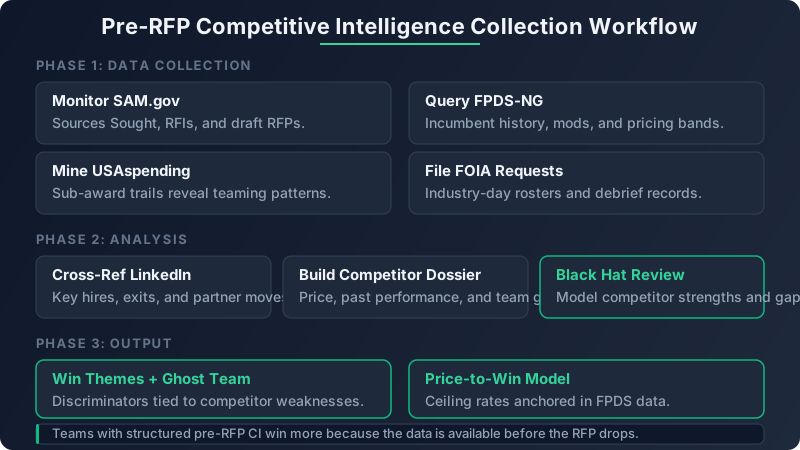
Start by querying FPDS by the target agency, NAICS code, and Product Service Code (PSC). This gives you every contract the agency has awarded in your domain over the past 5 to 10 years. You'll see who wins, how often, and at what dollar values. Sort by contractor and you'll quickly identify the 3 to 5 companies dominating that space.
Reading Modification Histories
Contract modifications are where the real story lives. A contract with 15+ modifications in 3 years tells you the scope changed significantly, which often means the agency wasn't satisfied with the original approach. Cost-type modifications (especially those increasing the ceiling) suggest the incumbent underpriced to win. Both are exploitable intelligence.
Look for patterns: Did the agency add new CLINs? Did they exercise all option years, or only some? A contract where option year 3 wasn't exercised is a flashing signal that the agency may be looking for a new provider.
Extracting Pricing Intelligence
FPDS records the total obligated amount and the potential contract value. Compare the initial award value against the final obligated amount across similar contracts. This gives you a pricing band for the agency's expectations. If your internal cost model comes in 30% above that band, you know you either need to restructure your approach or compete on technical differentiation rather than cost.
Building Recompete Timelines
Every contract has a start date and period of performance. Map these for your target agencies and you can predict recompetes 12 to 18 months out, well before any solicitation hits the street. I maintain a simple spreadsheet with contract number, incumbent, base period end date, and option year structure. When a contract enters its final option year, that's your signal to start shaping.
The Pre-RFP Competitive Intelligence Collection Workflow
USAspending Tricks That Reveal Hidden Teaming Relationships
USAspending.gov does something FPDS doesn't: it tracks sub-award data. And sub-award data is where teaming relationships become visible.
When a prime contractor reports sub-awards, USAspending records the sub-awardee name, amount, and location. This means you can see who your competitors are partnering with right now, on active contracts. If Competitor A is sub-contracting $3M annually to Company X for cybersecurity services, there's a strong chance that team will stick together on the next recompete.
Predicting Team Compositions
Pull all sub-awards under a target contract vehicle or agency. Map the prime-sub relationships into a simple network diagram. You'll often find that the same 4 to 5 companies rotate between prime and sub roles across multiple contracts. These are established teaming relationships, and they're hard to break.
This intelligence directly informs your own teaming strategy. If your strongest potential partner is already locked into a teaming arrangement with the incumbent, you need to know that before you build your capture plan around them.
Spotting Budget Shifts
Award transaction data on USAspending shows where agency dollars are flowing. If an agency that historically spent $20M annually on IT infrastructure suddenly starts obligating $8M on cloud migration services, that's a procurement signal. New spending categories mean new contracts, often with less incumbent advantage.
Small Business Set-Aside Intelligence
Cross-reference USAspending award data with SAM.gov entity registrations. If a contract was awarded as a small business set-aside but the current holder recently exceeded size standards (check their latest SAM registration), that contract may shift to full-and-open competition on the next recompete. That's an opportunity that most teams miss entirely.
Key Statistics
40-50%
Win rate for teams with structured pre-RFP CI programs, vs. 20-25% industry average
16M+
Contract actions searchable in FPDS-NG for free, covering all federal agencies
35%
Percentage of interested contractors who actually respond to Sources Sought notices
$0
Cost of a disciplined no-bid decision vs. $50K-$150K for a losing proposal effort
6-18 months
Optimal lead time for CI collection before anticipated RFP release
Pre-Solicitation Signals Worth More Than the RFP Itself
The RFP is the finish line of the shaping window, not the starting gun. By the time the solicitation is public, the agency has already decided what they want, often influenced by the contractors who engaged early.
Sources Sought and RFI Responses
Sources Sought notices and Requests for Information (RFIs) are the government's way of asking industry: "Can you do this, and how?" Only about 35% of interested contractors bother to respond. That's a mistake. A well-crafted RFI response positions your company as a credible, thoughtful provider. It lets you shape the agency's understanding of what's possible.
Write your RFI response to accomplish three things: demonstrate relevant past performance, introduce your technical approach without giving away proprietary details, and ask questions that subtly highlight your strengths. If your competitor can't do FedRAMP-authorized cloud hosting and you can, ask a question about the agency's cloud authorization requirements. You're not telling the agency to require it. You're making sure they think about it.
Congressional and Budget Signals
Agency procurements don't appear out of nowhere. They follow budget cycles. Track Congressional budget marks, agency Strategic Plans, and Inspector General (IG) reports. When an IG report flags deficiencies in an agency's cybersecurity posture, a cybersecurity contract is coming. When Congress adds $50M to an agency's modernization line item, those dollars need to be obligated.
The President's Budget Request, published each February, contains program-level funding details. Compare year-over-year changes to spot programs gaining or losing funding. Growing programs create new contracts. Shrinking programs mean fewer opportunities and more desperate incumbents.
Spotting Incumbent Dissatisfaction
Several signals indicate an agency is unhappy with their current provider: contracts that aren't extended through all option years, protests filed by the incumbent on related awards (suggesting a deteriorating relationship), GAO or IG reports criticizing program performance, and job postings from the agency for roles that overlap with contractor responsibilities (suggesting they may be considering in-sourcing). Any two of these signals together should move an opportunity up your priority list.
The Most Overlooked Free Intelligence Source
Industry day attendance lists are often available through FOIA requests, and some agencies publish them voluntarily. These lists tell you exactly who is seriously pursuing an opportunity. If you see 15 companies on the list but only 3 of them have relevant past performance, you've just narrowed your competitive field to 3. File your FOIA request within a week of the industry day for fastest results.
Building a Competitor Dossier That Actually Informs Your Win Strategy
Gathering data is not the same as producing intelligence. I've seen capture teams with 40-page competitor research documents that never influenced a single win theme. The problem: no framework.
Every competitor dossier should answer exactly five questions:
- Past performance: What similar work have they done, and how did it go? (FPDS mods and CPARS data if available)
- Pricing range: What have they charged for comparable scope? (FPDS obligated amounts and USAspending data)
- Key personnel: Who are their program managers and technical leads? (LinkedIn, press releases, prior proposal debriefs)
- Known partners: Who do they team with? (USAspending sub-award data, SAM.gov mentor-protégé registrations)
- Agency relationships: How embedded are they with the customer? (Current on-site staff, prior contract history, customer testimonials)
| Intelligence Area | Primary Source | Secondary Source | What to Extract | Red Flag Signal |
|---|---|---|---|---|
| Past Performance | FPDS-NG mod history | Debrief reports (FOIA) | Scope changes, ceiling increases, option exercises | Multiple mods increasing value by 50%+ |
| Pricing Range | FPDS obligated amounts | USAspending award details | Per-year burn rates, cost-type vs. FFP mix | Consistent underpricing followed by cost overruns |
| Key Personnel | LinkedIn profiles | Press releases, conference bios | PM tenure, clearance level, certifications | Key PM recently left the incumbent |
| Teaming Partners | USAspending sub-awards | SAM.gov entity search | Sub-award amounts, small business partners | Primary sub just won their own prime contract |
| Agency Relationships | Contract tenure (FPDS) | Industry day attendance | Years on-site, number of task orders | Contract not extended past base period |
Turning Data Into a Win Strategy
Once you have the dossier, run a structured Black Hat review. This isn't a brainstorm session where people guess what the competitor might do. It's a disciplined exercise where you use real data to draft the competitor's proposal outline, estimate their pricing, and identify their likely discriminators.
The output of the Black Hat should be a single page: competitor's probable win themes in the left column, your counter-strategy in the right column. If you can't articulate a credible counter for each of their strengths, you either need to adjust your approach or make a no-bid decision.
From Intelligence to Win Themes: Connecting the Dots
Intelligence that doesn't reach the proposal team is worthless. The bridge between CI and proposal content is your win theme architecture.
Map each piece of competitive intelligence to a specific evaluation criterion from the anticipated RFP structure. If FPDS data shows the incumbent has had three cost overruns on the current contract, your win theme for the Management approach should emphasize your track record of on-budget delivery. If USAspending data shows the incumbent's cybersecurity sub has been replaced twice, your win theme should highlight your stable, cleared cyber team.
Choosing Your Competitive Battleground
You can't win on every evaluation factor. Pick 2 to 3 where your intelligence shows the clearest gap between your capability and the incumbent's performance. These become your primary discriminators.
Pricing intelligence helps you make a critical strategic decision: compete on cost or differentiate on technical merit. If FPDS data shows the agency consistently awards to the lowest-priced technically acceptable (LPTA) bidder, your CI should focus on driving your price below the incumbent's. If the agency uses best-value tradeoff, invest your energy in technical differentiation and accept a moderate price premium.
Data-Driven Black Hat Reviews
A Black Hat review built on real data produces actionable output. One built on assumptions produces fiction. Before your next Black Hat, require every participant to bring at least three data points from FPDS, USAspending, or public sources. No speculation without evidence. This single rule transforms Black Hat reviews from guessing games into strategy sessions.
The Measurable Impact of Systematic Pre-RFP Intelligence
The Weekly CI Rhythm That Doesn't Require a Dedicated Analyst
You don't need a full-time intelligence analyst. You need 90 minutes per week, distributed across your BD team, following a repeatable pattern.
The 90-Minute Weekly Workflow
- Monday (20 min): Check SAM.gov saved searches for new Sources Sought, RFIs, and draft RFPs matching your target agencies and NAICS codes
- Tuesday (20 min): Review FPDS for new contract actions on target vehicles, particularly modifications and option exercises
- Wednesday (20 min): Scan USAspending for new sub-award disclosures under contracts you're tracking
- Thursday (15 min): Check LinkedIn for key personnel moves at competitor companies and target agencies
- Friday (15 min): Compile a one-page CI brief highlighting the 3 to 5 most significant findings from the week
Structuring the CI Brief
Nobody reads a 40-page intelligence report. Your weekly brief should fit on a single page with three sections: New Signals (opportunities entering the pipeline), Competitor Moves (personnel changes, teaming announcements, contract awards), and Action Items (specific tasks for the capture lead, like "draft RFI response for DHS Sources Sought notice due March 15").
Distributing the Work
On a 4-person BD team, assign monitoring lanes: one person watches SAM.gov, one monitors FPDS and USAspending, one tracks competitor activity on LinkedIn and press channels, and the capture lead synthesizes findings into the weekly brief. Each person invests roughly 20 to 25 minutes per week. The compound effect over 6 months is enormous.
Your First 48 Hours: A CI Sprint for Your Next Must-Win
Pick the one opportunity you're most serious about right now. Here's exactly what to do in the next 48 hours.
Hours 1 to 4: FPDS Baseline Query FPDS by the awarding agency and relevant NAICS/PSC codes. Pull the current contract details: incumbent name, award date, total ceiling, modifications, and option structure. Note the period of performance end date. Download the modification history and flag any ceiling increases above 20%.
Hours 5 to 8: USAspending Deep Research Search USAspending for the incumbent's prime award. Pull sub-award data. Map every sub-contractor, their dollar amounts, and the services they're providing. Check if any subs have their own SAM.gov registrations indicating they might compete as primes on the recompete.
Hours 9 to 12: Pre-Solicitation Signals Search SAM.gov for any Sources Sought or RFI notices related to this program. Check the agency's acquisition forecast (most agencies publish these annually). Review the latest IG report for the relevant agency program office.
Hours 13 to 16: Competitor Profiles Build a one-page dossier on the incumbent and the top 2 likely competitors using the five-question framework above. Check LinkedIn for the incumbent's current program manager and key staff.
Hours 17 to 20: Synthesis Compile findings into a one-page competitive landscape brief: who's competing, what they're likely to propose, where you have advantage, and where you're vulnerable. Identify 2 to 3 preliminary win themes based on gaps in the incumbent's performance.
This sprint connects directly to your compliance matrix and content reuse library. Once you know your win themes, you can start tagging relevant past performance examples and technical approach sections from previous proposals. When the RFP drops, you're not starting from zero. You're assembling pre-positioned content around a strategy built on evidence.
The contractor who wins your next must-win opportunity is gathering intelligence right now, this week, while you're still waiting for the RFP. Open FPDS-NG in a new tab. Run your first query. Ninety minutes a week is the difference between writing to win and writing to lose. Start tracking one metric this week: how many days before the RFP your capture effort begins. That number predicts your win rate better than anything else.