You open your latest proposal submission, confident your boilerplate past performance section will save you time. The contracting officer opens that same section and recognizes it word-for-word from three other proposals they evaluated last month. Your score drops before they reach paragraph two.
This isn't a hypothetical. This is what happened to a $47M IT services proposal I reviewed last quarter. The team reused a "proven winner" past performance narrative without updating contract numbers, project timelines, or agency-specific terminology. The evaluator's debrief notes literally said: "Generic boilerplate demonstrates lack of customization to our specific mission needs."
Content reuse isn't the problem. Lazy content reuse is the problem. The difference between a strategic content library and a folder of copy-paste disasters comes down to structure, governance, and ruthless quality control.
Why Your Current Copy-Paste Strategy Is Failing You
I have seen proposal teams lose competitive advantage because they treat content reuse like a file-sharing problem instead of a knowledge management discipline. You save a Word doc called "Technical_Approach_Cloud_v3_FINAL_FINAL.docx" and pray it is still accurate when you need it six months later.
Here is what actually happens. Evaluators recognize recycled boilerplate within the first three paragraphs. They have read hundreds of proposals. They know the difference between a thoughtfully adapted response and a mail-merge job. AI-assisted evaluation tools that agencies deployed in 2025 make this even worse. These systems parse proposals for requirement alignment, flag generic language that appears across multiple submissions, and dock scores for insufficient customization before a human ever reads your executive summary.
The 2026 FAR restructuring created a ticking time bomb in your content library. Security provisions moved from 52.204-xx to 52.240-xx. TINA thresholds jumped from $2M to $10M. CAS requirements shifted from $2.5M to $35M. If your reusable content still references the old clause numbers, you are submitting non-responsive proposals. One mid-tier defense contractor lost a $23M contract award last fall because their compliance matrix cited deprecated FAR clauses. Their content library had not been updated in 18 months.
Content decay is invisible until it costs you a win. Research from the Professional Services Council found that 15% of reusable proposal content becomes outdated every quarter. That means without active management, your entire content library is effectively obsolete within two years. Nobody tracks this. Nobody audits past performance narratives for expired contract periods. Nobody verifies that your CMMC compliance claims still match your current C3PAO assessment status.
Copy-paste creates compliance gaps when solicitation requirements evolve between proposals. You pull a technical approach section from a 2024 proposal into a 2026 submission without checking if the evaluation criteria changed. The original solicitation weighted past performance at 30%. The new one weights it at 45% and requires explicit small business subcontracting commitments. Your recycled content just missed 15% of the evaluation scorecard.
The Content Lifecycle: From Creation to Retirement
Content assets need lifecycle management just like physical inventory. You would not stock a warehouse with products you cannot track, expire, or reorder. Why do you treat proposal content differently?
Track content freshness with specific metadata. Every reusable content block needs: creation date, last use date, win/loss attribution, compliance verification timestamp, and owner assignment. This is not optional documentation. This is the difference between a content library and a content graveyard.
When I audit proposal teams' shared drives, I find content created in 2019 with zero usage tracking. Nobody knows if it won or lost. Nobody knows if the FAR clauses are current. Nobody knows if the project examples are still active contracts. This content sits there like expired inventory, waiting to contaminate your next proposal.
Content Lifecycle Management Process
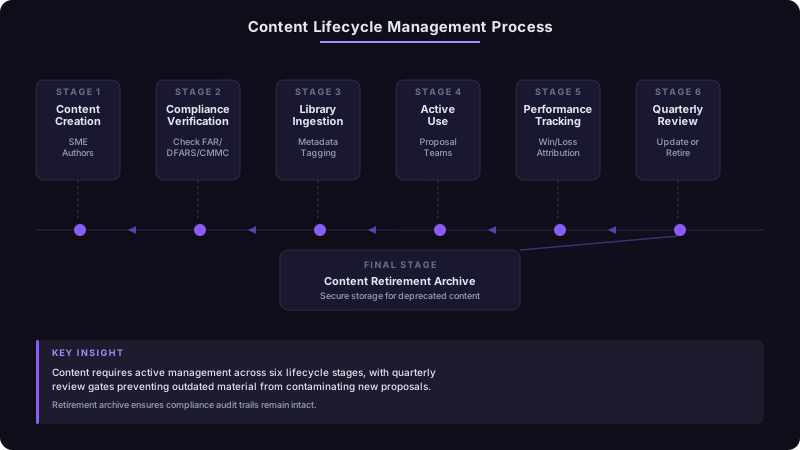
Establish content ownership roles with clear responsibilities. Subject matter experts author technical content based on actual project execution. Proposal managers curate the library, tag assets with metadata, and monitor reuse patterns. Compliance officers verify FAR/DFARS/CMMC references quarterly and flag content for retirement when regulations change.
Implement quarterly content audits using a three-tier review process. First pass: compliance verification. Check every FAR clause reference, every security control citation, every certification claim. Second pass: technical accuracy. Verify project dates, contract values, performance metrics against actual executed work. Third pass: competitive differentiation. Ask: "Does this content still give us an edge, or has it become table stakes?"
Retire content that has not been used in 18 months or has lost three consecutive evaluations. This is uncomfortable. Proposal managers resist deleting content because "we might need it someday." That someday never comes. What does come is the risk of accidentally including outdated, non-compliant, or competitively weak content in a live proposal.
Version control every content asset with solicitation-specific customizations tracked separately from master versions. Your base technical approach template should live at version 1.0. When you customize it for a specific solicitation, that becomes version 1.1-ABC-Solicitation-123. The master version stays clean. The customized version contains the agency-specific terminology, project examples, and evaluation criteria alignment that won (or lost) that specific opportunity.
Structuring Content for Dual-Audience Consumption
Federal agencies deployed AI evaluation tools faster than anyone built guidance on how contractors should respond. GSA, DoD, and civilian agencies now use AI for initial compliance screening, requirement alignment verification, and preliminary scoring. Your proposal gets parsed by machine learning models before a human contracting officer reads a single paragraph.
AI evaluation tools parse proposals differently than human evaluators. Humans tolerate narrative flow, contextual references, and implicit requirement satisfaction. AI tools need explicit requirement mapping, consistent terminology, and structured formatting. A human evaluator understands that your Section 3.2.1 addresses requirement L.3.2 even if you do not label it explicitly. An AI tool misses the connection and scores you non-compliant.
Structure reusable content with embedded metadata that survives both machine parsing and human readability. Tag each content block with requirement IDs, compliance keywords, and technical capability identifiers. When you reuse a past performance narrative, the metadata should include: contract vehicle (e.g., GSA OASIS Pool 1), agency customer (e.g., DHS CISA), technical domain (e.g., Zero Trust Architecture), and relevant NAICS codes.
The One Tag That Changes Everything
Add a "Last Win Date" field to every content asset. Track when this specific content block was used in a winning proposal. Content that has not contributed to a win in 12+ months needs immediate review. Either it needs improvement or your win themes have evolved beyond it. This single metric will transform how you manage your library.
Create extraction-friendly formatting that passes through AI parsing without losing structure. Use consistent heading hierarchies, numbered requirement callouts, and explicit compliance statements. Instead of writing "Our approach aligns with the agency's cybersecurity objectives," write "This approach satisfies Requirement C.3.1: Implement NIST 800-53 security controls across all system components."
Maintain parallel content versions for different evaluation stages. Create detailed technical specifications for AI screening phases and narrative summaries for human evaluation. When an agency uses AI for initial compliance scoring followed by human technical evaluation, you need content that satisfies both audiences. The AI version explicitly maps to every solicitation requirement by number. The human version tells the story of how your solution works in practice.
Tag content with solicitation terminology variations to improve AI matching accuracy across different agency vocabularies. One agency calls it "cloud migration." Another calls it "hybrid cloud modernization." A third agency uses "legacy system transformation." Your reusable cloud content should be tagged with all three variations so it surfaces in library searches regardless of which agency terminology the proposal manager searches.
Building Your Content Taxonomy: Beyond Folders
Most proposal teams organize content by client or by proposal year. This is useless for reuse. When you search for cloud security content, you do not want to browse through "DoD Proposals 2024" and "Civilian Agency Proposals 2025" folders hoping to find something relevant.
Organize by requirement type instead. Create top-level categories for: technical approach, management approach, past performance, staffing and key personnel, quality assurance, security and compliance, transition planning, and pricing strategies. Within each category, build second-level taxonomies by specific capability areas.
Tag content with multiple dimensions simultaneously. A single past performance narrative might be tagged with: capability area (cloud infrastructure), contract vehicle (GSA OASIS), security clearance level (Secret), geographic location (CONUS), past performance domain (DHS), technical stack (AWS GovCloud), and compliance framework (FedRAMP High). This multidimensional tagging means the same content surfaces in multiple relevant searches.
Create smart collections that auto-populate based on solicitation requirements rather than forcing proposal managers to browse folders. When you tag a solicitation with "CMMC Level 2 required" and "AWS cloud hosting," the system should automatically suggest every past performance narrative, technical approach block, and staffing resume that matches those criteria. Manual folder browsing is proposal management from 2015.
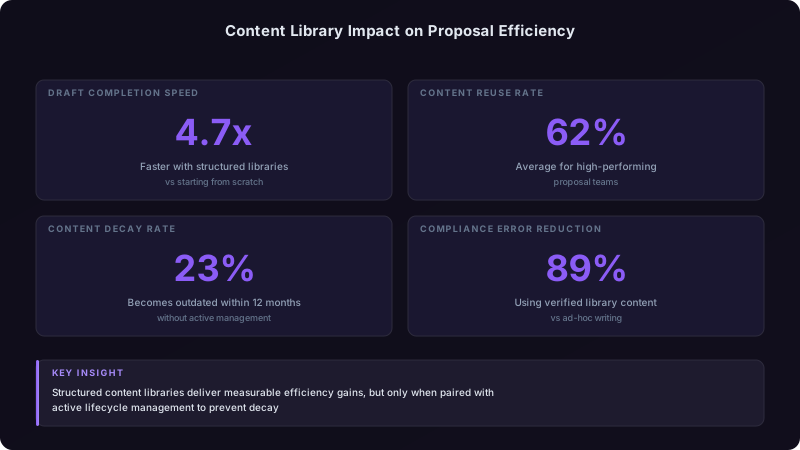
Key Statistics
4.7x
Faster first draft completion when using structured content libraries versus starting from scratch
62%
Average content reuse rate achieved by high-performing proposal teams with active library management
23%
Percentage of reusable content that becomes outdated within 12 months without quarterly audits
89%
Reduction in compliance errors when using verified library content versus ad-hoc writing under deadline pressure
Implement confidence scoring for each content block. Rate content on three dimensions: strength of differentiation (1-10), quality of evidence (1-10), and win attribution (proven winner, unproven, or proven loser). When a proposal manager searches for content, results should rank by confidence score. Your highest-performing, most-differentiated, evidence-backed content rises to the top. Weak or unproven content gets flagged for improvement or retirement.
Link related content assets across your library. Connect past performance narratives to the technical approach blocks they support. Link those technical approaches to the specific staffing resumes of people who executed that work. Cross-reference security compliance documentation to the technical solutions that implement those controls. These connections create content ecosystems instead of isolated fragments.
The CMMC Compliance Content Challenge
CMMC Level 2 certification requirements changed how you structure security-related reusable content. The November 10, 2026 Phase 2 implementation made third-party C3PAO certification the default for all contracts involving CUI. Your proposal content needs to reflect not just your security capabilities but your current certification status with specific control mappings.
Track certification status dates in content metadata. Every security-related content block should include: C3PAO assessment date, certification expiration date, NIST SP 800-171 control version, and assessment scope boundaries. When your certification expires or when you add new systems to your assessment boundary, every related content asset needs updating. This is not optional. DOJ's Civil Cyber Fraud Initiative prosecutes false certification claims. Getting this wrong is not a proposal loss. It is a potential federal investigation.
Create modular NIST SP 800-171 control mappings that update across all proposals when your certification status changes. Instead of hard-coding "We maintain CMMC Level 2 certification current through December 2026" into 15 different proposal sections, reference a single source-of-truth content block. When your C3PAO assessment gets renewed in December 2026, you update one block and it propagates through your entire content library.
Maintain separate content versions for self-assessment periods versus certified periods to avoid false certification claims. Before you achieve C3PAO certification, your content must use future tense: "We are pursuing CMMC Level 2 certification with assessment scheduled for Q2 2026." After certification, switch to present tense: "We maintain CMMC Level 2 certification validated by [C3PAO name] on [date]." Mixing these up creates liability.
Document subcontractor CMMC compliance in reusable teaming content with expiration date tracking. Your prime contractor obligations include verifying sub-tier cybersecurity compliance. When you build teaming content for repeat subcontractors, track their CMMC certification status, assessment dates, and scope boundaries. Primes like Lockheed Martin and Boeing already require Level 2 certification from subcontractors as a condition of teaming. Your content library needs to reflect current sub-tier compliance status, not assumptions from previous collaborations.
The C3PAO assessment bottleneck means contractors who started CMMC readiness in early 2026 are booking certification appointments for mid-to-late 2027. If your content claims "CMMC Level 2 certified" but you are actually self-attesting with a 2028 assessment target, you are submitting false statements. Track assessment status accurately and update content ruthlessly as your compliance posture changes.
Customization Without Starting From Scratch
The promise of content reuse is efficiency. The risk of content reuse is evaluator perception that you mailed in a generic response. Balance these by building customization requirements directly into your content templates.
Use content templates with required customization fields that must be populated before submission. Create a past performance narrative template that includes `[INSERT CONTRACT NUMBER]`, `[INSERT AGENCY NAME]`, `[INSERT PERFORMANCE PERIOD]`, and `[INSERT RELEVANT CAPABILITY MATCH]`. These fields force proposal writers to customize. They cannot accidentally submit boilerplate with someone else's contract details.
Create agency-specific content variants that incorporate terminology preferences and evaluation priorities. DoD agencies weight past performance and technical risk differently than civilian agencies. DHS prioritizes operational security and threat response. VA emphasizes user experience and interoperability. Your base technical approach content should spawn agency-specific variants that align with these evaluation patterns.
Maintain a customization checklist for each reusable block. Before including pre-written content in a proposal, verify: dates match the current solicitation period, contract numbers reference actual relevant work, agency names are correct, technical specifications align with solicitation requirements, and competitive differentiators still apply in the current market context.
Track which content blocks require heavy customization versus light editing to optimize reuse ROI. If a content block needs 60% rewriting every time you use it, it is not really reusable content. It is a starting outline. Focus your library development on content that needs only 10-20% customization per use. Those blocks deliver real efficiency gains.
Implement approval workflows that flag unchanged boilerplate for mandatory review before inclusion. If a proposal writer drops a past performance narrative into a proposal without making any edits, the system should require a compliance review before allowing submission. This catches accidental boilerplate inclusion before it reaches the evaluator.
| Customization Level | Required Changes | Reuse Efficiency | Best For |
|---|---|---|---|
| Light Edit (10-20% changes) | Update dates, contract numbers, agency names | High (saves 80% of writing time) | Executive summaries, corporate capabilities, technical methodologies |
| Moderate Edit (30-50% changes) | Adjust technical details, add solicitation-specific examples, align terminology | Medium (saves 50% of writing time) | Technical approach sections, management plans, quality assurance frameworks |
| Heavy Edit (60%+ changes) | Restructure narrative, replace examples, rewrite for different evaluation criteria | Low (saves 30% of writing time) | Past performance narratives, staffing plans, transition approaches tied to specific environments |
| Complete Custom (minimal reuse) | Use only as reference or inspiration | None (template-level value only) | Executive summaries for high-value pursuits, solution architectures for novel requirements |
Measuring Content Library ROI and Performance
If you cannot measure it, you cannot improve it. Content libraries deliver value through efficiency gains, quality improvements, and reduced compliance risk. Track specific metrics to justify the investment and identify improvement opportunities.
Track time-to-draft metrics. Measure how long it takes to complete a first draft with versus without structured library content. In my experience, proposals using well-organized content libraries complete first drafts 4-6 times faster than starting from scratch. A technical approach section that would take 16 hours to write from a blank page takes 3 hours when you start with proven library content and customize it for the specific solicitation.
Content Library Impact on Proposal Efficiency
Measure content win rate to identify your highest-performing content blocks and retire consistent losers. Tag each content asset with the proposals where it was used and whether those proposals won or lost. Calculate win rate as (wins using this content) / (total uses). Content with win rates below 30% needs immediate improvement or retirement. Content with win rates above 70% should be studied, replicated, and protected.
Calculate reuse rates by proposal section to identify gaps in your library coverage. If your technical approach sections average 65% content reuse but your staffing sections average 15% reuse, you have a staffing content problem. Either you lack sufficient resume diversity or your staffing content is not structured for reuse. Both problems are fixable once you identify them.
Monitor compliance rejection rates for reused content versus custom content. If your library content generates more compliance findings than freshly written content, your governance process is broken. Quarterly compliance audits should catch regulatory updates before they contaminate proposals. If they are not catching issues, you need more rigorous review protocols.
Track evaluator feedback mentions of boilerplate to adjust customization requirements. Debrief notes that mention "generic response," "boilerplate language," or "insufficient customization" indicate your content is not differentiated enough for reuse. Increase mandatory customization percentages for those content blocks or retire them entirely.
Implementation Roadmap: Your First 90 Days
You do not need a two-year transformation program to start benefiting from structured content reuse. You need a focused 90-day implementation that delivers immediate efficiency gains while building the foundation for long-term library management.
Days 1-30: Audit and baseline. Pull your last 10 proposal submissions. Identify the top 20 content blocks that appear across multiple proposals: executive summary frameworks, corporate capability statements, past performance narratives, technical approach methodologies, management plan structures. These are your library foundation. Simultaneously, establish your basic taxonomy structure organized by requirement type (not by client or year). Set up your metadata schema with required fields: creation date, owner, win/loss record, compliance verification date, and confidence score.
Days 31-60: Templatize and govern. Convert your top 20 content blocks into templates with required customization fields. Assign ownership roles. Designate subject matter experts as content authors. Assign proposal managers as content curators responsible for metadata accuracy and library organization. Designate compliance officers as verifiers responsible for quarterly audits. Implement version control with a clear master-versus-customized versioning scheme. Create your quarterly review calendar and assign specific review responsibilities.
Days 61-90: Train and measure. Run hands-on training sessions with your proposal team on how to search the library, customize templates, and contribute new content. Do not assume people will figure it out. Show them specific examples of proper reuse versus lazy copy-paste. Establish your quarterly review cadence with first review scheduled for day 120. Measure baseline reuse metrics: current reuse rate, time-to-draft averages, compliance error frequency. Set concrete success targets: 60% content reuse rate within six months, 40% reduction in first draft time, zero compliance rejections from outdated regulatory references.
Your success metrics after 90 days should include: At least 20 high-quality content blocks in your library with full metadata, a taxonomy structure that proposal managers can navigate without training, ownership assignments for every content asset, a quarterly review calendar with assigned responsibilities, and baseline reuse metrics that let you measure improvement.
The difference between a content library that scales and a digital junk drawer comes down to discipline. Start with a small, high-quality foundation. Add governance from day one. Measure everything. Retire ruthlessly. Customize strategically.
Your proposal teams will write fewer words and win more contracts. Your evaluators will see customized responses instead of recycled boilerplate. Your compliance officers will sleep better knowing outdated content cannot contaminate live submissions.
Build the library now. Your next proposal deadline is already closer than you think.