Software now reads some federal proposals before, or alongside, the people who evaluate them. That changes how you should write.
Your proposal now has two audiences. The first is a human evaluator who can interpret context, read between the lines, and give you the benefit of the doubt on an ambiguous phrase. The second may be software that summarizes your proposal or flags compliance for the evaluators. Agencies rarely publish how such tools work, so assume the worst case: a reader with no capacity for charity that reports only what it can parse, and if your formatting, structure, or evidence trails don't conform to what it expects, the evaluator may start from a summary that misses your best content.
This isn't speculative. Some solicitations now tell offerors that the government may use AI to help analyze and review proposals, for example to summarize content and identify compliance with solicitation requirements, while government personnel make the final evaluation judgments [3]. The question isn't whether software will read your proposal. It's whether your proposal is ready for it.
Your Proposal Now Has Two Readers, and One Doesn't Forgive Ambiguity
The dual-audience problem is real, and most contractors have not adapted to it. Agencies do not publish the internals of their review tools, but text-analysis software in general relies on three operations, so write for all three: tokenization (breaking your text into parseable units based on headers, paragraphs, and bullet structures), entity extraction (pulling out personnel names, contract numbers, dollar values, certifications), and semantic matching (comparing your language against evaluation criteria using vector similarity).
Here is where it gets painful. A phrase like "Our team brings extensive experience in comparable environments" might earn a nod from a human evaluator who reads the surrounding context. A tool looking for evidence finds nothing to extract from it when the requirement asks for "demonstrated experience on contracts of similar size and scope within the last five years." It wants contract numbers, dollar amounts, date ranges, and agency names. It does not infer. It extracts.
The formatting dimension compounds this. Parsers split content by section headers. If the RFP structures its evaluation factors as L.5.2.1, L.5.2.2, L.5.2.3, and your proposal uses a different numbering scheme (or none at all), a tool may fail to map your content to the right criterion, and a tired human evaluator may too.
Writing for both audiences requires a specific discipline: lead with machine-parseable specifics, then layer in the persuasive narrative humans respond to. Put the contract number, dollar value, and agency name in the first sentence. Use the second and third sentences to tell the story of what you delivered and why it matters.
How NLP Evaluation Tools Process Your Proposal Before Human Review
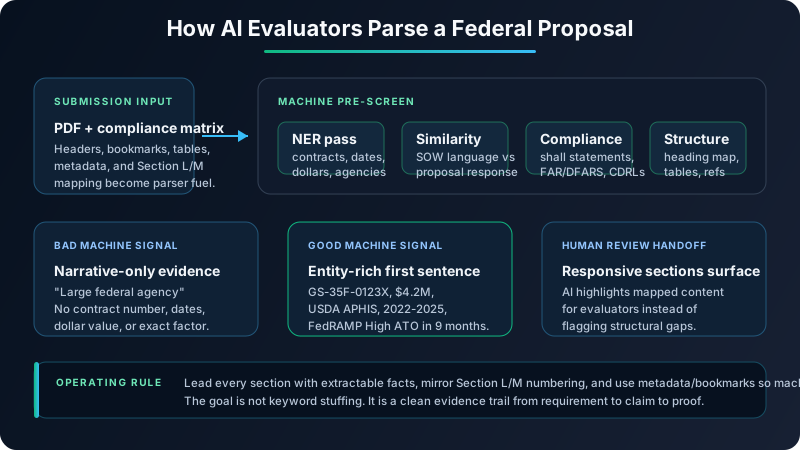
How Text-Analysis Tools Read Your Proposal
Understanding how text-analysis tools generally work gives you a concrete advantage. Write so your proposal holds up under four kinds of analysis.
Named Entity Recognition (NER) is the first. The tool extracts structured data points: personnel names and qualifications, contract numbers, dollar values, date ranges, agency names, NAICS codes, and certification identifiers (PMP, CISSP, AWS Solutions Architect). If your past performance narrative mentions "a large federal agency" instead of "U.S. Department of Agriculture, Animal and Plant Health Inspection Service," there is nothing to extract. You have made your evidence invisible to the machine.
Semantic similarity scoring is the second. The tool converts your proposal text and the SOW or Section M language into vector embeddings and measures how closely corresponding sections align. This is not about keyword stuffing: modern transformer models understand synonyms and paraphrasing. They struggle with responses that address the requirement obliquely or bury the responsive content three paragraphs deep. There is no published federal similarity threshold, so do not write to a magic number.
Compliance matrix verification is the third. The tool maps your content against mandatory requirements (certifications, clearances, insurance minimums, mandatory labor categories) and flags gaps. If Section L requires your approach to FISMA compliance and your response never mentions "FISMA," "NIST SP 800-53," or "Authority to Operate," a checker can report a miss even if your description of your security framework is excellent.
Structural analysis is the fourth. Does your heading structure match the RFP's? Are your tables parseable (not embedded as images)? Do your cross-references resolve? Reformatting the RFP's section numbering into your own corporate template is the most common way to lose this alignment.
Structured Formatting That Machines and Humans Both Prefer
The single highest-impact change you can make is mirroring the RFP section numbering exactly. If the RFP's Section L organizes requirements as L.5.2.1 Technical Approach, L.5.2.2 Management Approach, L.5.2.3 Past Performance, your proposal headings should read "5.2.1 Technical Approach," "5.2.2 Management Approach," "5.2.3 Past Performance." Not "Section A: Our Technical Solution." Not "Part III: Relevant Experience." The RFP's numbering. Verbatim.
Use a consistent heading hierarchy. H1 for volume titles (Volume I: Technical Proposal). H2 for major sections that correspond to evaluation factors. H3 for sub-requirements within each factor. Never skip levels. An H3 appearing without a parent H2 confuses both human readers and machine parsers.
Place your compliance claims in the first sentence of each section. NLP systems weight the opening sentences of a section more heavily when calculating semantic similarity, because well-structured technical writing front-loads the responsive claim. "Projectory Corp will provide a dedicated Program Manager with PMP certification and 12 years of federal IT experience" is a parseable, entity-rich opening sentence. "Our approach to program management reflects decades of institutional knowledge" is not.
For past performance, tables dramatically outperform narrative paragraphs for machine readability. Structure them with explicit column headers that match common NER extraction patterns.
| Column | Content Format | Why It Matters for NLP |
|---|---|---|
| Contract Number | GS-35F-0123X or W911NF-22-C-0045 | NER extracts and cross-validates against FPDS |
| Agency/Client | Full agency name, not abbreviations | Entity matching requires unambiguous references |
| Period of Performance | MM/YYYY to MM/YYYY format | Date extraction works on consistent formats |
| Contract Value | $4,200,000 (with dollar sign and commas) | Dollar value extraction needs standard notation |
| Contract Type | FFP, T&M, CPFF (spell out on first use) | Classification tags used in evaluation filtering |
| Relevance | Direct quote from SOW showing similarity | Feeds semantic matching against current requirement |
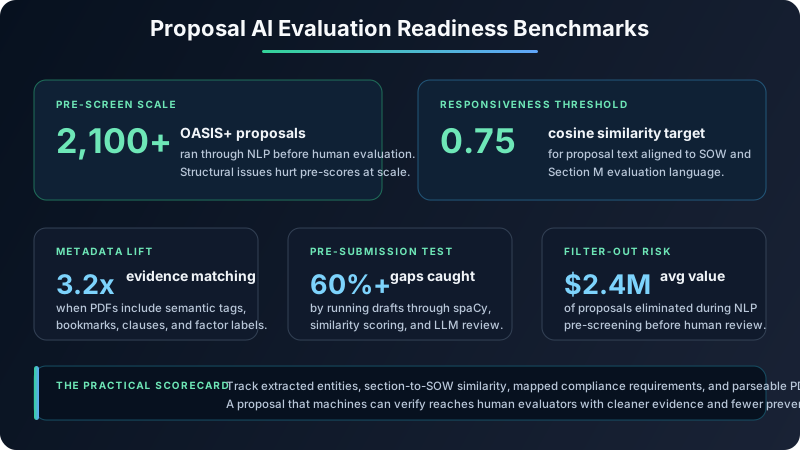
Proposal Formatting Impact on NLP Pre-Screening Scores
Semantic Metadata Tagging: The Technique Most Contractors Skip
Here is a step most contractors skip. They treat the proposal PDF as a static document and leave its metadata fields empty or wrong, even though indexing and document management tools read those fields.
PDF document properties (Title, Subject, Keywords, Author) are the first metadata layer. Set the Title field to the solicitation number and your company name. Set the Subject field to the evaluation factor language from Section M, verbatim. Populate the Keywords field with NAICS codes, FAR clause references (e.g., FAR 52.219-8, FAR 52.204-21), and key technical terms from the SOW. These metadata fields feed into indexing and pre-classification systems.
XMP (Extensible Metadata Platform) tags in Adobe Acrobat Pro provide a second, richer metadata layer. You can tag individual sections of your PDF with structured data: the evaluation factor each section addresses, the FAR clauses it complies with, the contract type of each past performance reference. For a cybersecurity bid, that could mean tagging each past performance narrative with the contract type (FFP, T&M), the NIST framework version referenced, and the ATO status. Metadata never replaces the narrative evaluators score, so keep every tagged fact in the body text too.
Structured bookmarks are the third layer. PDF bookmarks function as a machine-readable table of contents. When you create bookmarks that mirror your heading hierarchy (and match the RFP's section numbering), NLP parsers use them to navigate directly to relevant sections. Without bookmarks, the parser relies entirely on text-based heading detection, which fails when proposals use inconsistent fonts, sizes, or formatting for section headers.
Building these metadata layers takes about 45 minutes per proposal once you have a template. That's a trivial time investment compared to the months spent writing the proposal itself.
Machine-Readable Evidence Trails That Prove Compliance
Every compliance claim needs a machine-extractable evidence chain. This means moving beyond "we have done this before" to a format that NER systems can parse into structured data points.
Use an inline citation format that packs entity-rich data into a single sentence: "Under Contract GS-35F-0123X ($4.2M, 2022-2025, USDA APHIS), Projectory Corp delivered a cloud migration of 14 legacy systems to AWS GovCloud, achieving FedRAMP High ATO within 9 months." That single sentence gives the NER system a contract number, dollar value, date range, agency name, sub-agency, technical scope, cloud platform, compliance framework, authorization level, and timeline. Seven extractable entities in one sentence.
Cross-reference your compliance matrix entries to exact page and paragraph numbers, not just section headers. "See Section 5.2.1" forces the parser to re-scan an entire section. "See Section 5.2.1, page 23, paragraph 3" gives the system a precise location to validate the claim.
Build a Compliance Artifact Index as Your Final Appendix
Create a structured appendix that lists every compliance requirement from Section L/M, your responsive claim, the evidence artifact (contract number, certification ID, CPARS rating), and the exact page location. Format it as a table, not narrative text, and include it only where Section L allows it. It gives any reader, human or tool, a roadmap for validating your claims.
Testing Your Proposal Against NLP Before You Submit
You don't have to guess how an AI evaluator will score your proposal. You can simulate the evaluation before you submit. Here's the concrete testing pipeline I recommend.
Entity Extraction Validation
Install spaCy with the `en_core_web_lg` model. Run your proposal text through the NER pipeline and review the extracted entities. The command is straightforward:
import spacy
nlp = spacy.load("en_core_web_lg")
doc = nlp(open("proposal_section_5_2_1.txt").read())
for ent in doc.ents:
    print(ent.text, ent.label_)
Check whether the system correctly extracts your contract numbers (should tag as ORG or PRODUCT), dollar values (MONEY), dates (DATE), and personnel names (PERSON). If spaCy misses a contract number because you formatted it inconsistently, a federal NLP tool will likely miss it too.
Semantic Similarity Scoring
Use Hugging Face's `sentence-transformers` library (the `all-MiniLM-L6-v2` model works well for this) to compute cosine similarity between your proposal sections and the corresponding SOW paragraphs:
from sentence_transformers import SentenceTransformer, util
model = SentenceTransformer('all-MiniLM-L6-v2')

sow_text = "The contractor shall provide 24/7 network monitoring..."
proposal_text = "Projectory Corp will deliver continuous network monitoring..."

embeddings = model.encode([sow_text, proposal_text])
score = util.cos_sim(embeddings[0], embeddings[1])
print(f"Similarity: {score.item():.3f}")
Rank your sections by similarity score and revise the lowest first. A low score usually means you are not using the SOW's terminology, or the responsive content is buried too deep in the section.
Full Evaluation Simulation
Use an LLM with a structured prompt: paste the Section M evaluation criteria, then your proposal section, and ask the model to score responsiveness on a 1-5 scale for each criterion, citing specific gaps. It will not replicate any agency's tool. Focus on the gaps it flags, not the scores it assigns.
Before you paste a draft volume into any AI tool, confirm what the tool does with that content. Our trustworthy AI page explains how Projectory handles proposal data, workspace permissions, and human review of AI output.
When AI Evaluation Excludes You: Evaluation Rules and Protest Options
If you believe an NLP pre-screening tool incorrectly scored your proposal as non-responsive, you may have recourse. FAR 15.305(a) requires agencies to evaluate competitive proposals and assess their relative qualities "solely on the factors and subfactors specified in the solicitation" [1]. If an AI tool scored your proposal against criteria not in Section M, the evaluation departed from that rule. If a tool missed compliant content because of a formatting incompatibility, you may have grounds to argue the evaluation was unreasonable, but only if the evaluators relied on the tool's miss rather than reading the proposal themselves.
GAO protest standards apply to the evaluation, whoever or whatever made the error. GAO looks at whether the agency's evaluation was reasonable and consistent with the solicitation, and it also requires prejudice: "Competitive prejudice is an essential element of every viable protest, and absent a showing of prejudice, we will not sustain a protest" (MCI Diagnostic Center, LLC, B-422553.2, Aug. 9, 2024) [2]. A protest about an automated screening error therefore has to show that the agency's evaluation, not just the tool, got your compliant proposal wrong, and that without the error you had a substantial chance of award.
Request a debriefing under FAR 15.506 and specifically ask: "Were AI or NLP tools used in any phase of proposal evaluation, including pre-screening, compliance verification, or scoring?" If the answer is yes, ask how the tool's output was reviewed by the evaluators and whether it is part of the evaluation record.
Document everything on your end. If you built a compliance artifact index, tagged your PDF metadata, and used structured formatting, you have concrete evidence that your proposal contained the required information in machine-readable formats. This documentation makes your protest case substantially stronger than a vague claim that the agency "must have missed something."
A 30-Day Action Plan to Make Your Next Proposal AI-Ready
Stop treating this as a future problem. Every major federal procurement in 2026 has some NLP component in its evaluation pipeline. Here's your implementation roadmap.
Week 1: Structural Audit. Pull your last three proposal submissions. Compare your section numbering against the RFP's Section L structure. Count how many headings diverge from the solicitation's organization. Check whether your past performance tables use consistent column headers and data formats. Score yourself: did a parser could map every section to its corresponding evaluation factor?
Week 2: Metadata Template. Open Adobe Acrobat Pro and build a reusable XMP metadata template. Pre-populate it with common fields: solicitation number, NAICS code, contract type tags, evaluation factor keywords. Create a bookmark template that mirrors a standard Section L structure. Save it. You'll customize it per proposal, but the template cuts tagging time from 45 minutes to 15.
Week 3: NLP Pipeline Setup. Install spaCy and sentence-transformers in a Python environment. Write a script that takes a proposal text file and a SOW text file, runs entity extraction on the proposal, computes section-level similarity scores against the SOW, and outputs a report. This is a one-time setup that you'll reuse on every proposal.
Week 4: Live Test. Take your next active proposal draft. Run it through the full pipeline: entity extraction, similarity scoring, and an LLM-based evaluation simulation. Fix every gap the tools identify. Compare the pre-test and post-test similarity scores. Track the delta.
The metric to watch is your average section similarity score against the SOW, tracked from draft to draft. Rising scores mean your responsive content is easier to find, for software and for evaluators reading under time pressure.
References
- [1]FAR 15.305 Proposal evaluation. https://www.acquisition.gov/far/15.305
- [2]U.S. Government Accountability Office, MCI Diagnostic Center, LLC, B-422553.2, August 9, 2024. https://www.gao.gov/products/b-422553.2
- [3]Michael J. Brewer, "Should the Government Use AI Tools to Evaluate Contract Proposals?", April 7, 2026. https://www.burr.com/government-contracting/should-the-government-use-ai-tools-to-evaluate-contract-proposals