A federal prime I worked with had a 95% win rate on DoD IT modernization contracts. Three full-time proposal managers, a mature Shipley process, and a content library built over fifteen years of federal work. They decided to "go after SLED" in 2024 as a diversification play. Within six months, they had lost three consecutive state IT bids, burned through $340K in BD spend, and pulled the plug on the initiative entirely.
Their postmortem conclusion? "The SLED market isn't ready for enterprise solutions." The real answer was simpler and more painful: they treated state and local procurement like a miniature version of federal, and the market punished them for it.
State, local, and education (SLED) procurement exceeds $500 billion annually. That's not a rounding error. It's a massive, fragmented, and chronically undercompeted market that federal contractors keep ignoring, or worse, approaching with the wrong playbook entirely.
The $500 Billion Market Federal Primes Keep Ignoring
The math alone should get your attention. Federal contract spending hovers around $700 billion per year. SLED procurement sits north of $500 billion. Yet the vast majority of large federal contractors dedicate less than 5% of their BD resources to state and local opportunities.
The timing makes this more urgent than usual. Federal budget uncertainty, DOGE-driven workforce reductions across civilian agencies, and aggressive contract consolidation under the 2026 FAR overhaul are compressing the federal opportunity pipeline. Contractors who built their revenue base on steady federal task orders are watching those pipelines thin out. SLED diversification is no longer a "nice to have." It's a survival strategy for firms that need to fill gaps before fiscal year 2027.
But here's the core misconception that sinks most federal-to-SLED transitions: SLED is not a scaled-down version of federal procurement. It is a fundamentally different buying culture with different evaluation norms, different relationship dynamics, different compliance frameworks, and different timelines. The contractors who succeed in SLED are the ones who accept this on day one, not after three lost bids.
The procurement cycle alone tells the story. Federal source selections routinely stretch 6 to 12 months from RFP release to award. SLED procurement cycles run 40 to 60% shorter. Miss a state deadline because your review process assumed federal timelines, and you're waiting an entire fiscal year for the next shot.
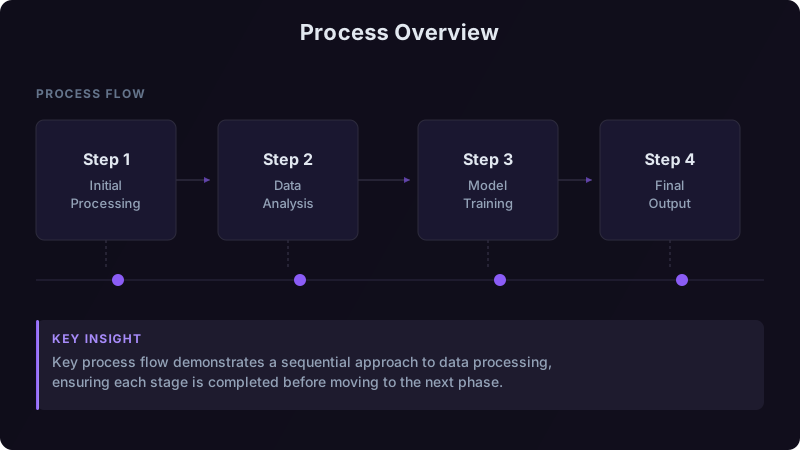
Process Overview
Your FAR Muscle Memory Will Sabotage You
Federal proposal teams develop deep muscle memory around the FAR. They know how to parse Section L and Section M. They can build a compliance matrix against FAR Part 15 structured source selection criteria in their sleep. That instinct becomes a liability in SLED.
State procurement codes vary wildly and share almost nothing with the FAR. California's Public Contract Code, Texas Government Code Chapter 2155, and New York State Finance Law are each their own ecosystems with unique terminology, evaluation criteria, and protest mechanisms. A compliance approach that works in Sacramento will fail in Albany.
SLED evaluations rarely follow FAR Part 15 structured source selection. Many states default to lowest price technically acceptable (LPTA) or use simple scoring rubrics with 100-point scales. The elaborate technical volumes that win federal contracts often hurt you in SLED, where evaluators want clear, concise answers to specific questions, not 80-page management approaches.
Here's the trap I see most often: federal teams apply a checkbox compliance mindset to SLED RFPs that value narrative responsiveness. A state RFP might embed its core requirements in paragraph form within the body text rather than structuring them into neat evaluation sections. If your team is scanning for L/M-style matrices and finding none, they'll either miss requirements entirely or default to generic federal boilerplate that reads like it was written for a different buyer. Because it was.
The 2026 FAR overhaul, which eliminated 484 pages and 2,724 requirements while renumbering thousands of clauses, is actually creating a useful forcing function. Federal contractors already have to rebuild their compliance matrices and update proposal boilerplate. This is the perfect moment to build SLED-specific content libraries from scratch rather than trying to retrofit federal language. If you're rebuilding anyway, build two libraries: one federal, one SLED.
SLED solicitations also tend to be shorter and less formally structured. A state IT modernization RFP might be 25 pages where the equivalent federal solicitation runs 120 pages. Less volume doesn't mean less complexity. It means the requirements are denser per page and require a different parsing approach. Tools built for federal proposal management need SLED procurement context to be useful here, and generic LLMs trained on federal procurement language will steer you wrong.
Where SLED Opportunities Actually Live (Hint: Not SAM.gov)
Federal contractors default to SAM.gov for opportunity discovery. In the SLED world, SAM.gov is nearly irrelevant. Over 80% of state and local solicitations are posted on state-specific portals that most federal BD teams have never logged into.
Every state runs its own eProcurement system. Texas uses the Electronic State Business Daily (ESBD). California posts on Cal eProcure. New York uses the Statewide Financial System portal. Florida uses MyFloridaMarketPlace. And that's just the state level. Counties, cities, school districts, and special districts each maintain their own procurement sites, often with no cross-listing.
Aggregators like GovWin IQ, BidNet Direct, and DemandStar exist specifically to solve this fragmentation problem. They are table stakes for SLED market entry, not competitive advantages. If your competitors are using them and you aren't, you're not even in the game. If you and your competitors both use them, the differentiation comes from what you do with the intelligence, not access to it.
Cooperative purchasing vehicles bypass traditional SLED solicitation entirely, and this is where smart federal contractors find their fastest path to revenue. NASPO ValuePoint, OMNIA Partners, and Sourcewell allow pre-competed contracts that states and localities can buy from directly. GSA Schedule holders can sell to SLED entities through GSA Cooperative Purchasing authority, but fewer than 15% of eligible contractors actively market this capability. That's a massive gap.
Pre-RFP digital discovery strategies matter even more in SLED because incumbent advantage is stronger. State agencies re-compete contracts with smaller bidder pools, and the incumbent often has a 6 to 12 month head start on relationship building. Monitoring state budget appropriations and procurement forecasts (both public data, often published 6+ months ahead) gives you the earliest possible signal that an opportunity is forming.
Key Metrics
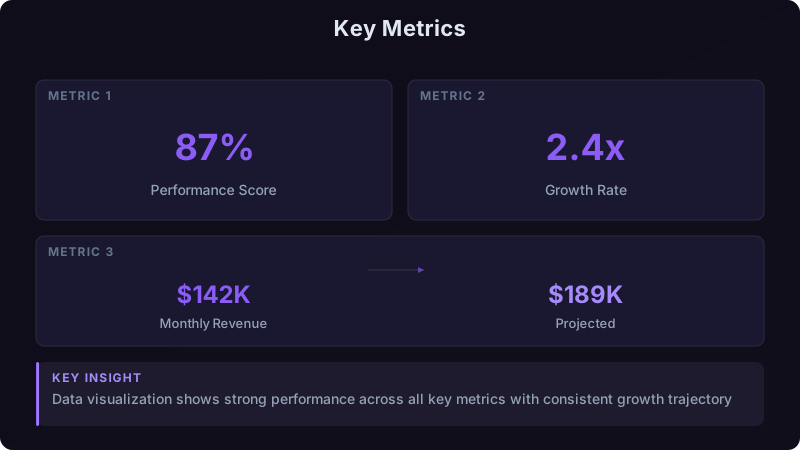
Key Statistics
$500B+
Annual SLED procurement spending, nearly 70% of federal contract volume, yet chronically undercompeted
< 15%
GSA Schedule holders who actively market cooperative purchasing to SLED buyers despite eligibility
40-60%
Shorter procurement cycles in SLED vs. federal, meaning your federal review process will miss deadlines
38
States now referencing NIST 800-171 or equivalent cybersecurity frameworks in procurement requirements
3-6 months
Typical SLED relationship-building timeline vs. 12-18 months for federal pre-RFP capture
The Relationship Gap Federal Teams Never Close
SLED procurement offices are small. Not small relative to federal. Just small. A state agency's procurement team might be 2 to 5 people handling dozens of active solicitations. County and city procurement shops are often a single person wearing multiple hats. This fundamentally changes the relationship dynamic.
In federal procurement, your contracting officer may never meet you in person before award. In SLED, the evaluator likely knows the incumbent contractor by first name, attends the same local industry events, and has a direct line to the project manager who delivered the last contract. This isn't corruption. It's the natural result of smaller communities and repeated interactions.
Federal BD timelines of 12 to 18 months pre-RFP are overkill for SLED. Relationships build in 3 to 6 months through industry days, association conferences (NASCIO for state CIOs, NIGP for procurement professionals, NACo for county officials), and direct outreach. The investment is smaller but the follow-through has to be faster and more personal.
Subcontracting to a local small business is the single fastest credibility accelerator in SLED markets. Many state and local buyers distrust large federal primes, associating them with over-engineered solutions, bloated overhead rates, and cost overruns. Partnering with a known local firm signals that you understand the community and are willing to share the work.
I watched a federal IT services firm win a $12M state network modernization contract after failing twice as a prime. Their third attempt succeeded because they partnered with a 15-person local MBE firm that had delivered three previous contracts to the same agency. The MBE firm contributed 30% of the work and 100% of the local credibility. The federal prime contributed the technical depth and project management maturity. Neither could have won alone.
The Fastest Path to SLED Credibility
Don't lead with your federal past performance. SLED buyers rarely care about your DoD work. Instead, identify a local MBE/WBE/DBE firm in your target state that has delivered 2+ contracts to your target agency, and approach them as a teaming partner. Offer them meaningful work share (25-40%), not a token subcontract. This single move addresses the three biggest barriers federal primes face in SLED: local references, small business goals, and buyer trust.
Pricing Structures That Win in SLED vs. Federal
The pricing model differences between federal and SLED are not subtle. They will determine whether you're competitive before an evaluator reads a single page of your technical approach.
Cost-reimbursement contracts barely exist in SLED. Fixed-price and time-and-materials contracts dominate, with fixed-price being the strong default. SLED buyers want to know exactly what they're paying, and they want that number to be the lowest compliant bid.
LPTA evaluations are the norm in SLED, not the exception. Federal contractors accustomed to best-value tradeoff source selections, where a higher price can be justified by superior technical approach, face a rude awakening. In many SLED procurements, if you're not the lowest priced technically acceptable offeror, you lose. Period.
State budgets also operate on different fiscal year calendars. 46 states run July through June, not October through September like the federal government. This means the "spend it or lose it" budget flush happens in May and June, not August and September. Time your bids accordingly.
| Factor | Federal | SLED | Impact on Federal Contractors |
|---|---|---|---|
| Dominant Contract Type | Cost-reimbursement, FFP, IDIQ | Fixed-price, T&M | Must reduce overhead to compete on price |
| Evaluation Method | Best-value tradeoff (FAR 15) | LPTA or simple scoring rubrics | Technical excellence alone won't win |
| Fiscal Year | Oct 1 to Sep 30 | Jul 1 to Jun 30 (46 states) | Budget flush and pipeline timing shift by 3 months |
| Protest Mechanism | GAO, COFC, agency-level | State procurement boards, varies by state | Federal protest experience doesn't transfer |
| Cost Data Requirements | TINA (now $10M threshold) | Rarely required | Simpler pricing, but higher competitive pressure |
| Small Business Goals | 8(a), HUBZone, SDVOSB | State-specific MBE/WBE/DBE programs | Federal certifications carry zero weight |
TINA thresholds and certified cost data requirements rarely apply in SLED, which simplifies your pricing process. But that simplification cuts both ways: with less cost justification overhead, more competitors can submit credible bids, and the price competition gets tighter.
Compliance Is Different, Not Easier
Federal contractors sometimes assume SLED compliance is simpler because there's no FAR. That assumption will cost you.
SLED cybersecurity requirements are catching up fast. 38 states now reference NIST 800-171 or equivalent frameworks in their IT procurement requirements. CMMC doesn't apply to SLED, but state data privacy laws create a patchwork compliance burden that can be harder to manage than a single federal framework. California's CCPA, New York's SHIELD Act, Texas HB 4, and Virginia's CDPA each impose different requirements on contractors handling citizen data.
Insurance and bonding requirements in SLED frequently exceed federal thresholds, especially for construction and infrastructure projects. A state transportation department might require a $10M performance bond on a contract where the federal equivalent would require half that.
Here's where federal contractors consistently stumble: disadvantaged business certifications don't transfer. Your federal 8(a) certification, HUBZone designation, or SDVOSB status carries zero weight in most SLED procurements. States run their own MBE, WBE, and DBE certification programs with separate applications, separate documentation requirements, and separate approval timelines. Budget 60 to 90 days for each state certification you pursue.
AI-assisted evaluation is emerging in SLED too. California and Virginia are piloting automated scoring for IT procurements, following the federal trend where agencies are deploying AI tools for compliance scoring and technical review. The January 2026 GAO protest involving AI bias questions in federal evaluation is raising the same concerns at the state level. If your proposals aren't structured for machine readability (clear headings, explicit requirement traceability, consistent formatting), you're already behind.
Building a SLED Capture Process That Actually Works
Stop retrofitting your federal Shipley process for SLED. A color team review cycle designed for 90-day federal response windows will choke a SLED bid with a 21-day turnaround.
SLED capture needs a lighter, faster framework with 4 to 6 week cycles from opportunity identification through submission. That means fewer review gates, smaller review teams, and pre-built content modules that can be assembled quickly.
Prioritize Your Target States
Not all 50 states are worth pursuing. Rank them by three factors:
- Total addressable spend in your NAICS codes (most states publish this data)
- Competitive density (how many incumbents hold current contracts in your space)
- Geographic proximity to your existing past performance and staff
A firm with strong IT modernization experience in Virginia should target neighboring states first (Maryland, North Carolina, West Virginia) rather than jumping to Oregon. Local past performance and existing relationships compound.
Separate Your Content Libraries
Build a SLED-specific content reuse library separate from your federal boilerplate. The tone, terminology, and structure differ significantly. SLED proposals should read less like federal government-speak and more like a clear business case written for a pragmatic buyer with limited time.
Federal boilerplate phrases like "in accordance with FAR 52.212-4" are meaningless in SLED. References to "the Government" should become references to the specific agency or entity. Your organizational experience section should highlight projects by state and locality, not by federal agency acronym.
Use the Right Tools
Purpose-built GovCon AI platforms with SLED procurement context will outperform generic LLMs that default to federal frameworks. A general-purpose AI tool trained primarily on FAR language will produce proposals that sound federal when you need them to sound local. This is the same dynamic the broader GovCon market is seeing as purpose-built platforms like GovDash and Procurement Sciences displace generic ChatGPT wrappers for federal proposals.
Track state procurement forecasts and budget appropriations as pipeline signals. These documents are public, often published 6+ months before RFP release, and they tell you exactly which agencies are planning to buy what. This is your SLED equivalent of pre-RFP digital discovery.
Your First 90 Days: A SLED Market Entry Playbook
Theory is worthless without a timeline. Here's what your first 90 days should look like:
Weeks 1 through 2: Reconnaissance
- Identify 5 target states based on spend data in your primary NAICS codes
- Register on each state's eProcurement portal (budget 2 to 4 hours per state for registration and verification)
- Pull the last 12 months of awarded contracts in your NAICS from each portal
- Map the incumbents, award amounts, and contract durations
Weeks 3 through 6: Vehicles and Access
- Identify cooperative purchasing vehicles you can sell through today (GSA Cooperative Purchasing, NASPO ValuePoint, Sourcewell)
- If you hold a GSA Schedule, verify your Cooperative Purchasing clause is active and your pricing is SLED-competitive
- Begin state-specific MBE/WBE/DBE certification applications for your top 3 target states
Weeks 7 through 10: Relationships
- Attend one SLED-focused industry event (NASCIO Annual Conference, NIGP Annual Forum, or a state-specific industry day)
- Schedule 10 meetings with state or local procurement contacts in your target states
- Identify 3 potential local teaming partners (small businesses with existing state contracts)
Weeks 11 through 12: First Submission
- Submit your first SLED response, even if it's a small contract ($50K to $200K)
- The goal is not to win. The goal is to build the muscle, identify process gaps, and calibrate your team's speed
Track time-to-submit as your key metric. If your SLED proposal takes longer than 50% of your federal cycle time for a comparable scope, your process is too heavy. Strip out review gates until you hit that target.
The federal prime I mentioned at the start could have avoided $340K in wasted BD spend with a structured 90-day entry plan. Instead, they applied their federal process to SLED, assumed their DoD past performance would carry weight, and priced their solutions 30% above competitors who understood the market. The SLED market didn't reject them. Their approach rejected the market.
Start with one state. One teaming partner. One bid. Build from there. And stop treating $500 billion in annual procurement as an afterthought.